


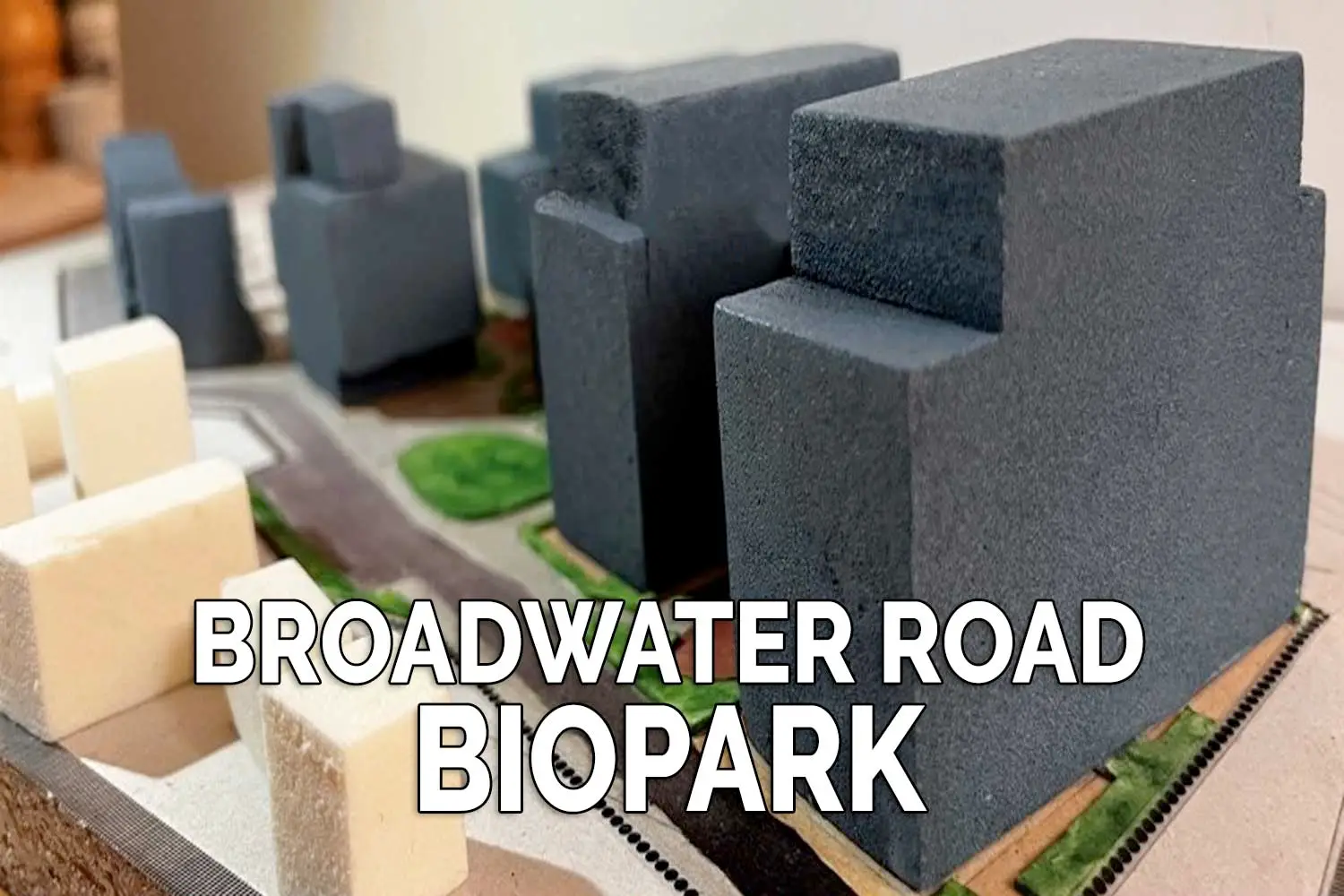
We consider the implications of the recent decision on the BioPark site, Broadwater Road.
On 25 August the outcome of the BioPark planning inquiry was announced. We were bitterly disappointed to learn that the Inspector upheld the appeal by the developers HG Group. In March this year HG Group appealed against the Council’s refusal in September 2021 of their scheme to build dense high-rise tower blocks on their site on Broadwater Road. Following an appeal, an application must be considered by a planning inspector, appointed by the Secretary of State. Consequently an eight-day public inquiry took place in July, led by Inspector Michael Boniface. Our Society felt strongly that the Council’s refusal should be upheld, as did the Welwyn Garden City Heritage Trust and Keep the G in WGC.
Our Society applied for and gained Rule 6 status, which permits interested community groups to put forward their views at the public inquiry. Members will now know what an enormous effort went into presenting our case. We are very grateful to William Walton, who acted as the Society’s advocate in the appeal, and to the expert witnesses who appeared to support our case (see below). The Society is indebted to Clive Wilson, who presented our case at the inquiry. He was supported by many fellow members, notably Elahe Taylor, David Doughty, Richmond Bauer, John Fogarty and Gerry Crux. Without their work, the Society’s involvement in the inquiry would have been impossible.
The BioPark Inspector’s decision shows that the absence of a credible local plan from the Council has exposed residents to future over-development across the Borough. The Council failures were laid bare in clinical detail by the developer’s barrister in the Inquiry proceedings. The Inspector appears to be saying that the lack of a local plan trumps all local policies and objections. We note that it is not the Garden City residents’ fault that there is no local plan, but they are left to bear the consequences.
The Society felt that the Inspector made a number of statements that appear to be contradicted by the evidence, such as his assertion that
“very good public transport options exist and future residents would not need to be reliant on private cars”.He also failed to mention material local issues that were raised, for example, that permission for the existing height of the BioPark buildings was granted for employment use, not residential. We are left with the impression that the Inspector’s decision was based on selected facts, that he dismissed local policies and that he ignored local objections. Please write to Grant Shapps MP if you are concerned that central government has decreed local policies, and objections have no weighting.
So what are the implications of this decision?
The two large sites near the former Shredded Wheat buildings are both the subject of planning applications which have yet to be heard by the Council’s Development Management Committee. These applications greatly increase the height and density of the already permitted schemes, one of which (the South Side) is already under construction. But both developers have in recent months been indicating that their proposals may change again, and have held public consultations. The BioPark appeal decision will of course whet their appetite for greater height, more densely packed buildings, and bigger profits. The Society wants to see well-designed modern housing on these sites in order to meet the housing shortage, and it will continue to fight for this. However, the Inspector’s report on the BioPark included the following sentence:“The density of the [BioPark] scheme, in numerical terms, would be high for the area. Higher than the majority of development in the locality and higher even than that of the development under construction in the … area. However, that is not in itself objectionable. What is important, is not the numerical figure, but any harm that would arise from that density. In this case, I have found none.”This judgement could open the door to unsuitable development throughout the Borough. We believe that taller, denser tower blocks will create irreversible harm in Welwyn Garden City. The dwellings they create lack the outdoor space, light, and human scale which are at the heart of Ebenezer Howard’s vision for healthy living and for garden cities. On Broadwater Road they will loom over the town, compromising its unique character. The Society will fight for better housing, appropriate to our town, and your support is vital.
